How To Save Money By Wasting Less Food

22 Days Of Blogging- Day 3

The tips in this post could potentially save you 40% on your food bill forever.

Wasting food is a common health coaching conversation because most people are spending a lot of money on their healthy food only to throw a large portion of it out.

Throwing away food is unfortunately the current norm in our society. About 40% of all food that is ever produced is never eaten, it is thrown away and wasted. Think on that for a moment. All of the energy that is spent to create food and almost half of it is destined for the landfill rather than the tables of people who it was grown for. On a personal level, the average individual is also throwing away about 40% of the food they purchase at the grocery store.

Since I have learned how to stop throwing out my fair share of food, I can tell you that using all of the food you buy without waste is a skill. It requires you to become food conscious from the time you are at the store to the time you are forced to deal with the leftovers.

Here are 5 ways that I keep food waste to a minimum:

  1. Plan your meals. Make a menu of what you’re going to eat for breakfasts, lunches, and dinners this week and then fill your pantry and fridge. Keeping a regular theme (i.e. Taco Tuesday) is a great way to keep your favorites on the menu and your fridge stocked.
  2. Keep a whiteboard note of what is available or possible to eat in the fridge right on the door. This is also a good place for family members to make requests and write down food items you will need for your next grocery shopping trip.
  3. Store your food properly. Veggies that are stuck in a plastic bag on the bottom of that drawer in the fridge often get forgotten. Instead, place them into a reusable airtight container and that will preserve their flavors and nutrients better. Most vegetables will only store for a few days so have a plan to use them or freeze them.
  4. Plan to eat leftovers. Cook once, eat twice. Put aside a few servings for later that week or in the freezer for anytime. It can be really helpful to make a few things in one cooking session so overall you end up spending way less time over the stove.
  5. Pick one day a week to clean out the fridge. This can also be when you challenge yourself to make a meal with only what you have in the fridge and pantry. Get rid of the stuff before it goes bad.

Reducing your food waste is a simple and smart way to save money. Imagine how different your food budget might feel if you were eating all of it.
Surviving The Holidays With Food Sensitivities

File Dec 08, 11 20 19 AM

21 Days of Blogging- Day 2.

Few things seem to bring out people’s food issues like sharing a meal at the holidays.

During this time of year you’ll hear about people gaining 10 pounds of ‘holiday weight’ as they gorge themselves on the lovely indulgence of traditional dishes that don’t always serve a healthy or healing body.

During these festive get togethers my sensitivity and avoidance to foods that contain gluten, dairy, sugar, some nightshades, and corn frequently feels like an issue or an inconvenience if I’m the only one eating that way.

If you would have known me several years ago I was the first one to the table as I sampled through everything the table had to offer and then go back for seconds. Family dinners were awesome.

Those awesome eating experiences changed when I quit eating gluten and dairy. People generally don’t have any idea how to modify their recipes (nor do I ever expect them to do so only for me) so unless I expose my digestive system to gluten and dairy I am left out from enjoying everything on the menu. My experience has often been that I will be able to eat the meat (when I’m eating meat) if it doesn’t have any weird spices or sauces and I can eat the veggies if they are not dressed with butter or cheese. It is a very limiting experience and if not planned for a major let down while everybody else is drooling over their decadent food and you are left with plain food.

  1. When possible, talk with the host beforehand about what is being planned for the menu and ask if you can bring anything and/or if they can set aside your portions without dairy and sauces containing gluten.
  2. Bring your own dishes or sauces and make enough to share. Your dish might be the one thing on the table you will eat.
  3. Be grateful. No matter if you can only eat one thing on the table, you can eat one thing. Enjoy every healthy bite while you share time with loved ones.
  4. Prepare to have other people feel bad for you because you are so fragile and limited and can’t indulge like they can. Ugh.
  5. Try to keep your manners and not be judgemental when people tell you how they know they would be much healthier if they gave up certain foods and then proceed to pile said foods on their plate, eat them up in front of you then complain about their indigestion and bloated bellies after dinner. Its an odd experience for me to watch and an exercise in holding my tongue.
  6. Prepare to not be able to have dessert. This one hurts. As a foodie, this one hurts. Bring your own, if possible.
  7. Remember why you are skipping the foods that cause angst in your body. Honoring your body with the best food possible will leave you feeling better in the morning.

When you face food limitations because of your health, you also get to witness how limited other people are in the same old food habits they don’t feel are necessary to upgrade.

Good luck keeping your food healthy this holiday season! We got this.

See you tomorrow.

Pam Dyer is a Holistic Health Coach who trains people with scoliosis and chronic illness how they can improve sleep, gut health, immunity, and brain function to live full and hurt less.  To book a consult with Pam please email:  butterflysessions@gmail.com  

The Legal Washington CBD/THC Suppository Experience

File Oct 28, 10 49 01 AM

*NOTE: This is an independent, unsolicited review of a legal Washington product in stores now. 

There is only one cannabis suppository in the legal 502 retail marketplace brought to us by the good people at CPC in Seattle. I’ve been really waiting to try it because I’m super skeptical about the effectiveness of their 10mg/THC dosages.

I like to keep cannabis infused suppositories in my medicine cabinet as a method of managing back and body pain, pelvic cramps, sleeping issues, or anytime I can feel my body is really run down. I swear by them as one of the most effective ways to benefit from medical cannabis.

The challenge comes in being able to buy a good cannabis suppository. Before legal retail cannabis was set up in Washington and consolidated with medical, I was getting my suppositories in the former system from a reputable medical provider and eventually  learned how to safely make my own.

My former suppository experiences have involved using 50-200mg/THC doses with the effects being substantial in relieving pain, and helping me have restful sleep without a heady high.  I’ve only ever used ones made with coconut and whole plant cannabis concentrates, not a very solid product at most room temperatures.

The product I tried from CPC is made with two ingredients, shea butter and cannabis concentrate. From briefly talking to the gentleman who created them, I learned that they chose shea butter due to its ability to hold a form and still be bioavailable to people who are sensitive or allergic to other commonly used oils such as coconut, a personal favorite of mine.

The packaging was easy to read, allowed me to see exactly what I was purchasing, and was not messy to get into. Major bonus.

I also know that the cannabis oil they use is from a company who is conscientious about only using plant matter that was not treated with pesticides. This is a very important point for me.

I took a dose about an hour before bedtime and waited. In the past I would feel a warmth in my pelvis that would wash over my lower body and relax everything in about 15-20 minutes and depending on the dose put me into a restful sleep. After about 30 minutes I still felt nothing. The nagging ache in my hip was not softened or muted, it did nothing to help me sleep that night, plus I woke up just as sore as I would have any other morning.

Basically, taking this suppository felt like a total joke to me, not noticeably beneficial at all. Because of state laws on dosage control, this product is limited to provide 10mg/THC. Weak.

When using it, I appreciated that it mostly held its form during insertion even being stored at room temperature. I would definitely suggest putting it in the fridge or freezer before use to make it a little more firm for easy insertion.

The bottom line for me was that the overall experience was weak and totally overpriced. I certainly can’t blame the company for not putting out a higher dosage when they are limited by laws. More than anything I appreciate that they have stepped up to put out a quality medical type product in a recreational market.

However, would I ever buy it again? Probably not until the dosages significantly increase. I would rather go through the effort to make my own higher dosed recipe with reputable concentrates and coconut oil at home than ever waste my budgeted medical cannabis money on this particular product again.

I have talked to only one other person who has used these and they said they did feel slightly less achy the next morning when using it before bed but did not have a significantly therapeutic experience.

There must be somebody out there finding them helpful though because they have stayed on the market for a while now. If there is ever a better product to come out in the legal market, I will let you know.

Peace.

Pam Dyer is a Holistic Health Coach who trains people with scoliosis and chronic illness how they can improve sleep, gut health, immunity, and brain function to live full and hurt less.  To book a consult with Pam please email:  butterflysessions@gmail.com  

The Positive Sides Of Scoliosis

Scoliosis2017

Scoliosis is bleak, every single part of it. If you are somebody who is inflicted with this challenging health condition you already know that living with a twisted spine can be scary, daunting, defeating, debilitating, and lonely. I feel all of that.

Since age 12 I have been repeatedly told I need surgery and have been prescribed and given samples of pain killers, muscles relaxers, and anti-inflammatories because of my scoliotic spine. I was once told by one doctor never to hang and told by the next to hang everyday. I have spent more time than I care to count wasted in physical therapists and specialists offices who did nothing for me besides tell me to keep doing what I am doing with pilates, yoga, and as a fitness trainer. They like to tell me that my spine will get worse with each aging year, until it eventually crushes my heart and internal organs and potentially collapses on itself. Like I said, bleak.

Scoliosis is much more than just a twisted spine. It is a neuromuscular disorder that may also manifest with other health conditions such as digestive disorders, muscle spasms, depression, anxiety, migraines, etc.

I put a lot of effort into the function of my spine and have since I was a teenager because I realized at an early age that I would always have to be mindful of my special back, it was never going away. I think about how I want to move as I age and move accordingly. More than once I have completely changed my livelihood, activities, and/or my food in order to manage it holistically without surgery or prescribed medications.

One of the toughest things about scoliosis is how lonely it can be. I have a lot of energy and rarely ‘complain’ about my back pain and focus on healthy things so on the outside it looks like I am a super health nut doing just fine with my spine. People don’t see the pain or discomfort that I am generally feeling because I keep it to myself. That’s no good.

June is Scoliosis Awareness Month

What is the positive side of Scoliosis?

  1. I’ve become very in tune with my body. Pain, discomfort and constantly needing to think about standing straight or straightening your clothes will do that to a person. On another level, when I’ve tuned in with with meditation and exercise I’ve been taught by my body how to cope and move through the world.
  2. I’ve been forced to be a ‘healthy person’ to function. Living a healthy lifestyle is not an option like it seems to be for most people and it can be really tough to be the only one at the party not drinking booze or eating sugar. But hey, you’re at the party! While it is tough, living healthy is a good and positive thing to keep as a priority, always.
  3. I look at body image much differently. When I am able to embrace myself as different I am also able to let go of what I think I am supposed to be and love who I am, imperfections and all. I tend to be very grateful for all I can physically do no matter how small.
  4. My spine contributes to me being highly sensitive, empathic, and wise. I can’t explain why but it just does. Spiney senses.
  5. I’ve become a powerful warrior of chronic pain with special strengths and coping skills that makes me strong enough to handle not only my own pain but also help others handle their pains. My spine is the reason that I started teaching fitness as a teenager and the reason that I went to Institute of Integrative Nutrition in 2010, I have a deep desire to help people feel well.

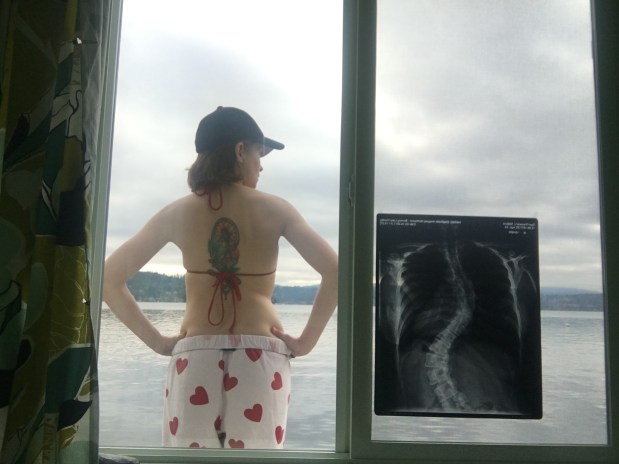
I am participating in Scoliosis Awareness Month by writing this and sharing a picture of me beside an X-ray of my spine. Funny, it was much harder to post a picture of my bare back than to post a picture of my X-rays. I worked through it.

Sending out much love and double hugs to those who live with or support somebody with scoliosis.

Pam Dyer is a Holistic Health Coach who trains people with scoliosis and chronic illness how they can improve sleep, gut health, immunity, and brain function to live full and hurt less.  To book a consult with Pam please email:  butterflysessions@gmail.com